Older Article
Newer Article

29 May 2026
Given the ongoing conflicts across several regions of the world, many travellers are affected not just by rising oil prices but also by flight disruptions, delays, and cancellations.
The most pressing question on travellers’ minds, then, is whether their travel disruption can be covered by travel insurance. Well, that depends entirely on the cause of the disruption.
Many travel insurance websites state that travel disruptions such as flight delays or cancellations can be covered. However, the reason for the delay or cancellation matters.
Travel disruption due to an “act of war” is not usually covered by insurers. This is usually in the fine print of terms and conditions that may not be so obvious if you don’t know what you’re searching for.
Understanding the coverage terms and conditions before buying travel insurance or booking your flight helps you better prepare for any surprises that may arise.
Not sure if your plan covers what matters most?
Use the Hospital Bill Estimator to see what your expected
costs could be.
Quick answer:
Travel insurance usually does not cover losses caused directly or indirectly by acts of war, military conflict, invasion, civil unrest, or warlike operations.
If your flight is delayed or cancelled because of conflict, airspace closures, military action, or a known war-related event, your claim may be excluded even if you bought travel insurance.
However, you may still be covered for unrelated insured events, such as illness, injury, baggage delay, or ordinary travel delays, depending on your policy wording.
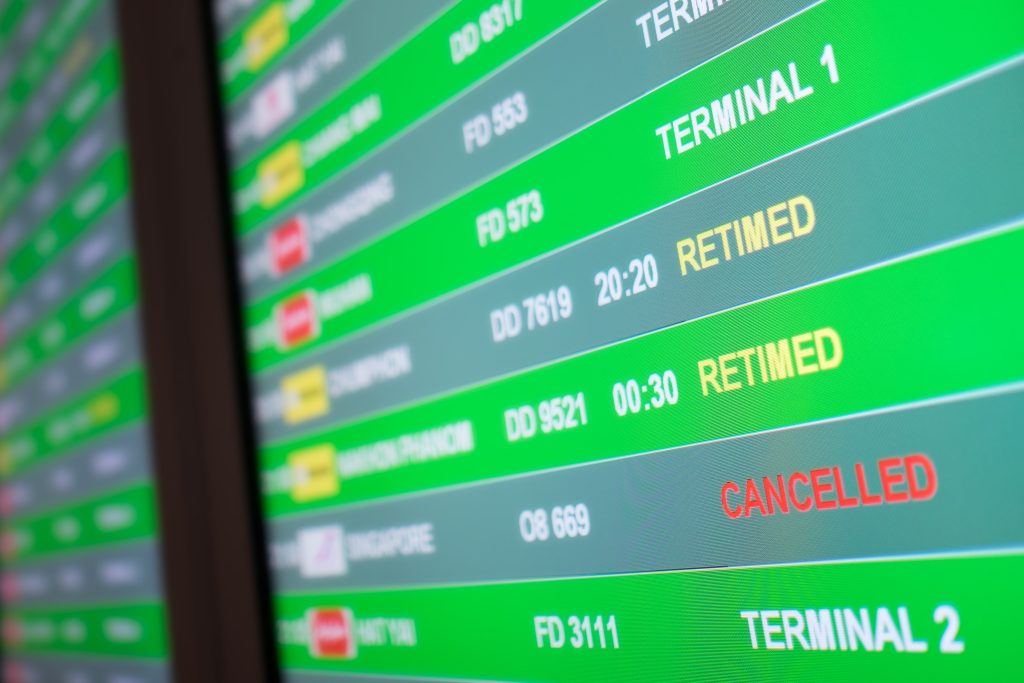
Travel insurance commonly covers situations such as trip cancellation, trip postponement, travel delay, missed connections, and additional accommodation or transport costs. However, the exact coverage depends on the policy terms.
In general, coverage applies only when the disruption is caused by an insured event listed in the policy. Common covered events may include illness, injury, natural disasters, transport breakdowns, or certain airline disruptions.
Some policies may also mention that travellers can claim for trip cancellations or delays “for any reason”. However, this should not be read as blanket coverage. “For any reason”, benefits usually come with specific conditions, exclusions, limits, and purchase deadlines. Travellers should still refer to the full policy wording before assuming that any cancellation will be covered.
Another common misunderstanding is the order of claims. If an airline, travel agent, hotel, or tour operator offers a refund, credit, rebooking, or compensation, travellers may need to approach them first before travel insurance pays for any unrecovered costs.
Insurance typically does not reimburse expenses that have already been refunded, credited, or compensated by another party. This means that if your airline has already provided a refund or rebooking option, your insurer may not pay for the same cost again.
Situation | Usually claimable? | What to check |
|---|---|---|
Flight delayed due to airline
technical issue | Possibly | Travel delay benefit and minimum delay
hours |
Flight cancelled due to airline
schedule change | Possibly | Airline refund or rebooking options
first |
Flight cancelled due to war or
military conflict | Usually no | War, conflict, and known event
exclusions |
Trip cancelled because of government
advisory | Depends | Advisory clause, purchase date, and
policy wording |
Medical emergency unrelated to
conflict | Possibly | Overseas medical coverage limits |
Baggage delay unrelated to conflict
| Possibly | Baggage delay benefit and
documentation |
Voluntary cancellation by traveller
| Often limited | Cancellation reason, timing and policy
conditions |
Most travel insurance policies exclude losses directly or indirectly caused by war, warlike operations, invasion, rebellion, civil unrest, or similar conflict-related events.
This means that even if your flight is delayed or cancelled, the claim may not be accepted if the disruption is linked to war or military conflict.
The General Insurance Association of Singapore also notes that most travel policies have a total exclusion on war risks, meaning losses arising directly or indirectly from war and civil commotion are not covered, as well as travelling to specific countries such as Afghanistan or those listed by insurers.
Travellers should therefore not assume that a flight cancellation linked to conflict is automatically claimable. Even if the disruption is outside your control, the exclusion may still apply.
Some insurers also treat active conflicts as “known events” once they are widely reported or formally listed by the insurer. Once an event is considered known, buying a policy after that point may not provide coverage for related disruptions.
For instance, MSIG Singapore has stated that the ongoing conflict involving Israel, the United States and Iran is considered a known event. United Overseas Insurance has also stated that its policy does not cover claims arising directly or indirectly from war, hostilities, retaliatory strikes, or military actions.
The key point is this: when conflict is involved, the wording of the policy matters. A general travel delay benefit may not override a war or conflict exclusion.
If the airline cancels or reschedules your flight, your first source of support is usually the airline rather than the insurer.
Depending on the airline’s policy and the circumstances, you may be offered rebooking, refunds, travel credits, meals, accommodation, or rerouting. These options should be checked first before making a travel insurance claim.
Travel insurance may help with additional unrecovered expenses, but only if the policy covers the disruption and no exclusion applies. For example, if the cancellation is due to a covered airline disruption and you incur extra accommodation or transport costs, you may be able to claim those expenses, subject to policy limits.
However, if the cancellation is linked to conflict, airspace closure, military action, or a known war-related event, the claim may be excluded.
Travellers should also be careful not to cancel flights too quickly on their own. A voluntary cancellation may affect refund eligibility or reduce claim options. It is usually better to wait for written confirmation from the airline if a flight is cancelled, delayed, rescheduled, or rerouted.
Keep all documentation, such as airline emails, cancellation notices, receipts, accommodation invoices, and written responses, as they can all help support a later claim.
Who pays first when your flight is cancelled?
In most cases, travellers should check support in this order:
Even when war-related disruption is excluded, travellers may still be able to claim for other covered events that occur during the same trip.
For example, claims may still be possible for non-war-related insured events such as illness, injury, baggage delay, or an ordinary travel delay unrelated to the conflict. Some policies may also cover additional accommodation, meals, local transport, or missed connections if the reason falls within the list of covered events.
However, claims linked directly to war, military action, or known conflict are usually excluded, even if the traveller suffers real financial loss.
A “cancel for any reason” benefit, where available, may offer broader flexibility. Even then, it usually comes with conditions. These may include buying the policy within a specific time after booking the trip, cancelling within a stated timeframe, and accepting that only a portion of the trip cost may be reimbursed.
The final claim outcome depends on several factors:
This is why travellers should not rely only on product summaries or sales pages. The full policy wording is what determines the claim outcome.

Government travel advisories can affect whether a destination is considered safe or insurable.
Singapore’s Ministry of Foreign Affairs released travel advisories in March 2026 advising Singaporeans to defer travel to the Middle East. Advisories like these are important because they may affect both travel decisions and insurance claim eligibility.
MFA later reiterated in April 2026 that its travel advisory for the Middle East remained valid, and urged Singaporeans to defer all travel to the region.
Advisories like these are important because they may affect both travel decisions and insurance claim eligibility.
Buying travel insurance after a conflict or advisory has already emerged may limit or remove coverage for related disruptions. Once a conflict becomes a known event, insurers may treat losses arising from that event as no longer unexpected.
Travelling against official advice may also affect claim eligibility, depending on the policy wording. Some policies exclude claims if travellers proceed to a destination despite government warnings or advisories.
For this reason, travel insurance is strongest when purchased early, before disruptions become known events. Buying insurance only after a conflict escalates, flights are cancelled, or advisories are issued may leave travellers with limited protection.
Before buying travel insurance, travellers should check whether the policy excludes:
Remember to review the sections on trip cancellation, travel delay, missed connections, and curtailment. These sections explain when you can claim if your trip is cancelled, shortened, delayed, or disrupted.
Medical coverage should also be reviewed separately. Even if conflict-related travel disruption is excluded, outpatient medical treatment, hospitalisation, and emergency evacuation may still be covered for unrelated events, depending on policy terms.
Travellers should also check whether the insurer treats conflict-related disruptions as known events. Insurers may publish notices on their websites when certain conflicts, strikes, weather events, or outbreaks are considered known events.
Before travelling, save important contact details on your phone. This includes:
The more prepared you are before departure, the easier it is to respond calmly if plans change.
If your trip is disrupted by conflict, contact the airline first to confirm your rebooking, refund, travel credit, or rerouting options. Airlines are usually the first party responsible for handling cancelled or rescheduled flights.
Next, contact your travel insurer before incurring additional costs where possible. This is especially important if you need to book extra accommodation, alternative flights, or local transport. Your insurer can clarify whether the cost may be claimable before you spend more.
Keep all documentation. This includes:
Travellers should also check Singapore MFA advisories and register with MFA eRegister when travelling to higher-risk destinations. This helps the authorities contact you during emergencies.
Most importantly, avoid assuming that all disruption costs are claimable until the insurer confirms the policy terms. Travel insurance can be helpful, but it does not cover every unexpected event.
Travel insurance is useful, but it does not cover every disruption.
Conflict-related events are often excluded or limited, even when travellers have no control over what happened. This can feel frustrating, especially when flights are cancelled or trips are disrupted for reasons outside your control.
However, understanding policy exclusions, claim order, and documentation requirements can reduce confusion during an already stressful situation.
Before booking your next trip, take time to check your policy wording, government travel advisories, insurer notices, and airline cancellation rules. The more you understand before departure, the better prepared you will be if plans change.