Older Article
Newer Article


09 Jun 2026
About this article:
When it comes to health insurance in Singapore, many people think of coverage as one single policy.
But in reality, your medical bill may be supported by several layers of coverage working together. This is often referred to as insurance stacking.
In Singapore, the main layers of health insurance usually include MediShield Life, Integrated Shield Plans, Riders, and Corporate Insurance. For some people, Critical Illness Insurance may also provide important financial support, although it works differently from your hospitalisation insurance (i.e., MediShield Life + Integrated Shield Plan). Additionally, your MediSave (although not a type of health insurance, rather more like a national health saving scheme) can also play a part in reducing your actual out-of-pocket cash.
Each layer plays a different role. Some help pay for hospital bills. Some reduce co-payment. Some apply only if you are employed. Some are not technically insurance, but can still help reduce the amount you need to pay in cash.
Understanding how these layers work can help you make better decisions before admission, surgery or treatment and avoid surprises when the final bill arrives.
Insurance stacking means using different types of healthcare financing and insurance coverage together to reduce your out-of-pocket costs.
For example, a Singapore Citizen or Permanent Resident may have:
The key thing to understand is this: these layers do not all work the same way.
Some are designed to pay hospital bills. Some reduce co-payment. Some reimburse eligible expenses. Some provide a lump-sum payout. Some only apply after another layer has paid. Some are subject to claim limits, deductibles, co-payment, panel rules, referral rules, or pre-authorisation requirements.
That is why knowing your coverage before treatment matters.
Not sure if your plan covers what matters most?
Use the Hospital Bill Estimator to see what your expected
costs could be.
MediShield Life is the basic national health insurance scheme that is compulsory for all Singapore Citizens and Permanent Residents. It provides lifelong protection (including all pre-existing conditions) and helps pay for large hospital bills and selected outpatient treatments. It is designed mainly around subsidised care in public hospitals, such as Class B2/C wards, rather than private hospital bills. However, it can still cover a portion of hospital bills if you choose treatment in private hospitals.
MediShield Life is important because it forms the base layer of your hospitalisation coverage. Even if you later buy an Integrated Shield Plan (IP), MediShield Life still remains part of that coverage. The Ministry of Health (MOH), Singapore, states that MediShield Life is included in all Integrated Shield Plans and continues to cover you for life, including pre-existing conditions, even if those conditions are excluded under the private insurance portion of your IP.
However, MediShield Life does not cover every dollar of every bill. It has claim limits, deductibles, and co-insurance. For your MediShield Life, the annual claim limit is S$200,000 per policy year, with no lifetime limit on claims.
In simple terms: MediShield Life helps reduce the bill, but it may not be enough if you choose higher ward classes, private hospitals, or treatments with costs above the scheme’s claim limits.

An Integrated Shield Plan, or IP, is the private insurance that sits on top of your MediShield Life. It gives you additional coverage beyond your basic MediShield Life layer.
Depending on the type of IP you buy, it may provide coverage for:
An Integrated Shield Plan is essentially made up of two parts: your MediShield Life and additional private insurance coverage from a private insurer, if purchased.
This is where many of us can reduce our out-of-pocket exposure significantly. For example, if you want the option of private hospital care, a private hospital IP may help cover a larger part of the bill than MediShield Life alone.
However, an IP does not mean “everything is fully paid”. Now, you may still need to pay a deductible and co-insurance, unless you have a rider that helps reduce (but not 100%) these portions. You also need to check whether your doctor is on your insurer’s panel, whether pre-authorisation is required, and whether your treatment is covered under your policy terms.
In simple terms: Your Integrated Shield Plan increases your coverage, but your final out-of-pocket cost still depends on your plan type, hospital choice, doctor choice, treatment type, and policy conditions.
A Rider is an optional add-on to your Integrated Shield Plan. It is designed to reduce the amount you need to pay out of pocket, usually by helping with deductible and/or co-payment portions.
But riders are changing.
Since 1 April 2026, new IP riders sold in Singapore can no longer fully cover the minimum IP deductibles set by MOH. The co-payment cap of these new Riders will be raised to a minimum of S$6,000 per year, excluding the minimum IP deductible. The minimum 5% co-payment requirement remains unchanged.
These payments do not necessarily have to be entirely paid in cash, as you can still utilise your MediSave for these compulsory out-of-pocket requirements. However, the amount covered by your MediSave is subject to prevailing withdrawal limits.
This is important because some people assume a Rider means they will pay nothing. Or on the contrary, that their out-of-pocket costs will be exorbitantly high. Both ways of thinking miss out of certain aspects of this whole health insurance journey.
A Rider is still useful because it can reduce your out-of-pocket requirements, but it does not remove the need to understand:
In simple terms: A Rider can reduce your out-of-pocket cost, but it may not reduce it to zero.

Corporate Insurance is coverage provided by your employer. This can be a helpful additional layer, especially for working adults.
Depending on your company’s benefits, Corporate Insurance may help cover:
However, Corporate Insurance varies widely from employer to employer. Some plans have annual limits. Some require a GP referral before seeing a specialist. Some only cover panel providers. Some may cover outpatient care but have limited hospitalisation benefits. Others may coordinate with your personal insurance plan.
This is where many people get caught.
For example, you may think, “I have Corporate Insurance, so I should be covered.” But your claim may still depend on whether you followed the correct referral pathway, whether the provider is recognised, whether the treatment is eligible, and whether your annual limit has already been used.
According to MOH’s claims protocol, if you are covered under multiple schemes, employer benefits, private insurance, or other third-party payers are generally used first, followed by your MediShield Life/Integrated Shield Plan, then MediSave, and finally cash.
This means your Corporate Insurance may help reduce the amount that needs to be claimed from your personal health insurance or paid out of pocket. However, it should not be assumed as automatic full coverage.
In simple terms: Corporate Insurance can be a valuable extra layer, but you need to know the rules before treatment.
MediSave is not insurance. It is your own healthcare savings under CPF. But it plays a major role in reducing your cash out-of-pocket costs because it can be used for approved medical expenses (inpatient and outpatient), subject to withdrawal limits.
According to CPF, MediSave can be used for hospitalisation, day surgery and surgery, with limits depending on the type of care and complexity of the procedure. For example, your MediSave can be used up to S$830 per day for hospital charges for day surgery, and between S$240 and S$5,290 for surgery, depending on the complexity of the operation.
This matters because even after your insurance pays, there may still be a remaining amount. Your MediSave can help offset some or all of that amount, depending on the bill type and withdrawal limits.
In simple terms: MediSave can help reduce the cash you need to pay, but it is subject to limits and may not cover the entire remaining bill.
Critical Illness Insurance is slightly different from the other layers in your health insurance stack.
Unlike MediShield Life, an Integrated Shield Plan, a Rider, or Corporate Insurance, Critical Illness Insurance usually does not reimburse your hospital bill directly. Instead, it provides a lump-sum payout if you are diagnosed with a covered critical illness, subject to your policy’s definitions and claim conditions.
This means the payout can often be used more flexibly. For example, it may help with:
For example, a cancer patient may have hospitalisation coverage through their MediShield Life, an Integrated Shield Plan, and a Rider. These layers may help pay for eligible hospital bills, surgery, inpatient treatment, or selected outpatient cancer treatments.
But cancer can also bring other financial pressures, such as time away from work, repeated appointments, additional scans, transport, nutritional needs, caregiving arrangements, or recovery support. This is where their Critical Illness Insurance can help, not by reducing the hospital bill directly, but by providing cash support during a difficult period.
However, it is important to note that Critical Illness Insurance only pays out if the condition meets the policy’s definition of a covered critical illness. Different policies may define conditions differently, especially older policies compared with newer ones. Some policies may cover only later-stage illnesses, while others may include early or intermediate-stage coverage if you bought an early Critical Illness Plan.
In simple terms: Critical Illness Insurance is not usually part of the hospital bill payment stack, but it can be an important financial support layer if a serious illness affects your income, recovery, and everyday expenses.
A hospital bill may be reduced in stages.
First, the bill is assessed for claimable and non-claimable items. Not every charge may be claimable under every insurance plan.
Then, depending on your coverage, the stack may work something like this:
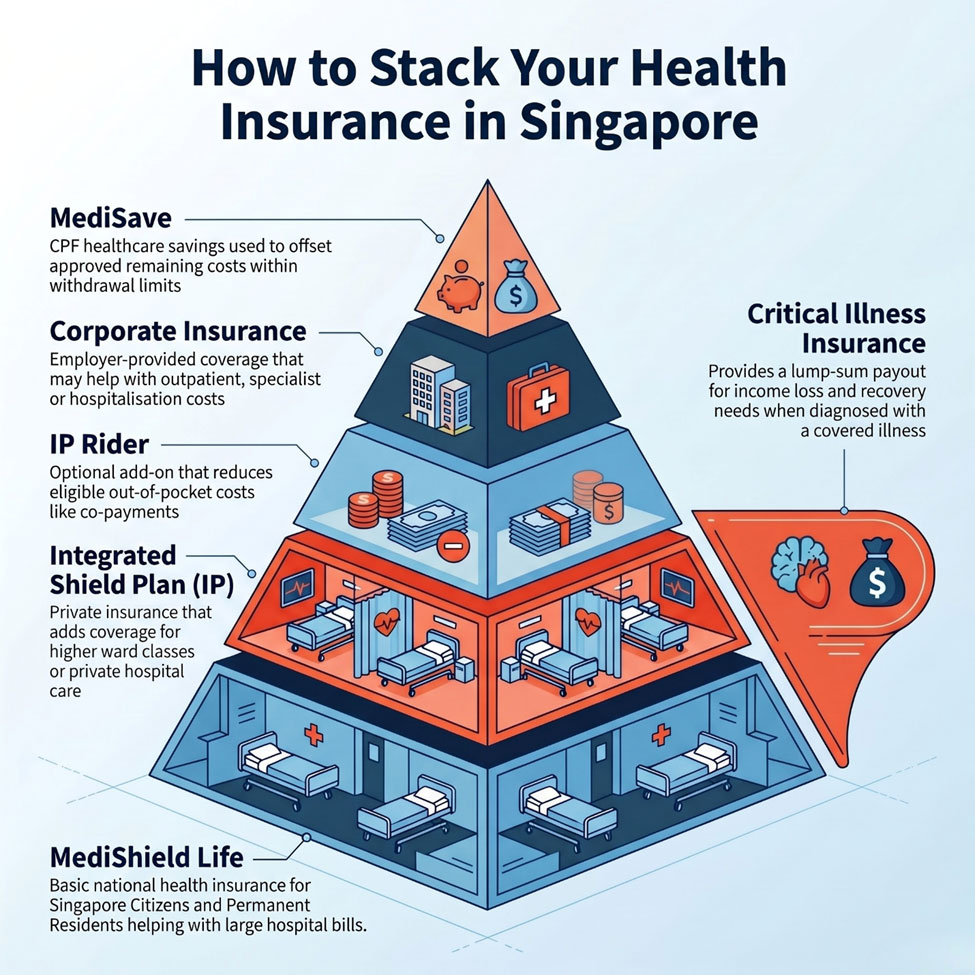
Any amount not covered by insurance or MediSave will need to be paid in cash.
The goal of insurance stacking is not to make every bill free. The goal is to reduce the risk of a large, unexpected cash payment.
If you have Critical Illness Insurance and your diagnosis meets your policy’s claim definition, the payout will be made as a lump sum. This may not be tied directly to the hospital’s bill payment process.
That means you may still use your hospitalisation insurance (MediShield Life + Integrated Shield Plan), Rider, Corporate Insurance, and MediSave to manage the bill, while using your Critical Illness Insurance payout to support other financial needs such as income loss, caregiving, home recovery, or non-bill expenses.
Many unexpected bills happen not because someone has no insurance, but because they misunderstand how their insurance works.
Common mistakes include:
The safer approach is to check your coverage pathway early.
Insurance stacking in Singapore is about knowing how each layer works and using them in the right order.
The more clearly you understand your stack, the better prepared you are to make treatment decisions with confidence.
Before you need care, take time to check your coverage. It may make a meaningful difference to what you eventually pay.